
Choose CPT if you need paid or unpaid training tied to your course before you graduate; choose OPT if you want work authorisation you can use before or after your studies finish. CPT is authorised by your Designated School Official (DSO) directly in SEVIS. OPT needs USCIS approval and an Employment Authorisation Document (EAD). One important catch: a full year or more of full-time CPT eliminates your OPT eligibility at that same degree level.
TL;DR:
- Full-time CPT exceeding 12 months at a degree level disqualifies you from eligibility for OPT at that same level, regardless of when or how often it occurs.
- CPT requires a signed job offer and DSO approval entered into SEVIS before you start working, while OPT necessitates USCIS approval and an EAD before employment begins.
- Students can apply for post-completion OPT as early as 90 days before graduation and must file within 60 days afterward to avoid losing eligibility.
- Part-time CPT does not impact your OPT eligibility, but full-time CPT across multiple sessions can cumulatively eliminate your OPT rights.
- Prior to filing, ensure your internship timeline aligns with OPT filing windows and avoid starting work before your authorization documents are issued.
Table of Contents
- OPT vs CPT: the basic framework every F-1 student needs
- What is curricular practical training (CPT)?
- What is optional practical training (OPT)?
- OPT vs CPT: key operational differences
- Eligibility, timing and common edge cases to watch
- How to apply: step-by-step actions for CPT and OPT
- STEM OPT extension and cap-gap: what to expect
- Does CPT affect OPT? Sequencing, overlap and mistakes to avoid
- What Edelia has learned helping students plan CPT and OPT
- Let Edelia handle the planning while you focus on your course
- Sources
- FAQ
OPT vs CPT: the basic framework every F-1 student needs
Both CPT and OPT sit under the same umbrella. F-1 students get two forms of “practical training” that let them work in the United States while studying, and the rules governing each come from different corners of the immigration system.
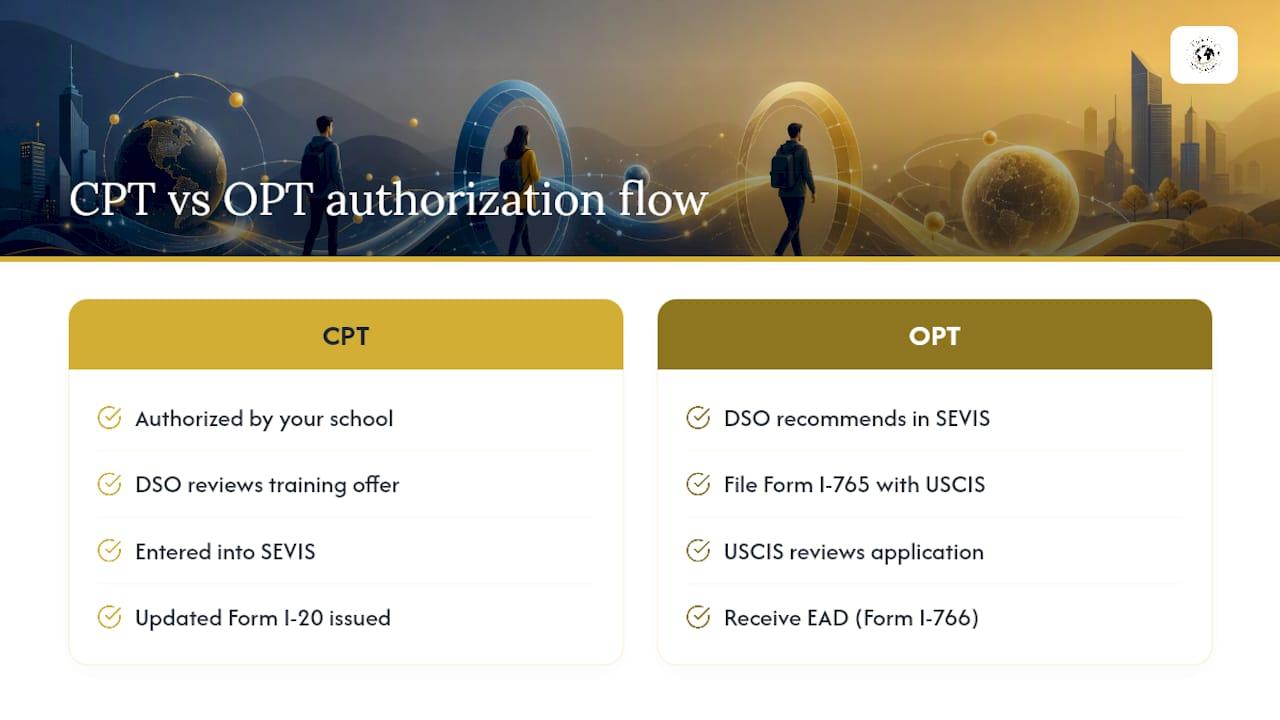
CPT is authorised entirely by your school. Your DSO reviews your training offer, enters it into SEVIS, and issues an updated Form I-20 showing the CPT dates. No USCIS involvement, no separate work permit.
OPT works differently. Your DSO recommends it in SEVIS, but you then file Form I-765 with USCIS and wait for an EAD (Form I-766) before you can start working. OPT splits into two phases: pre-completion, used while you’re still enrolled, and post-completion, used after you finish your programme. Most students use post-completion OPT, since it delivers a fuller year of work authorisation without academic constraints competing for your time.
What is curricular practical training (CPT)?
CPT is training that’s genuinely part of your degree, not just a job you happen to have while studying. Internships, cooperative education placements, and required practicums all typically qualify, but only when they’re written into your curriculum, such as a course that mandates work experience or carries academic credit.
Eligibility comes with one firm rule: you generally need to have completed one full academic year before applying, unless your graduate programme requires practical training from the outset. Your DSO authorises each period of CPT directly in SEVIS, and the training must be integral to your curriculum, not just adjacent to it.
Beyond the academic requirement, CPT demands:
- A secured job offer or signed cooperative agreement with a specific employer before authorisation
- DSO sign-off entered into SEVIS with an annotated I-20 showing exact CPT dates
- Employer- and date-specific terms. Switch jobs, and you need fresh authorisation
- A distinction between part-time CPT (20 hours a week or less) and full-time CPT (over 20 hours)
That last point carries real weight. Rack up a full year or more of full-time CPT, and you lose OPT eligibility at that same degree level entirely.
What is optional practical training (OPT)?
OPT gives you up to 12 months of work authorisation per degree level, usable before graduation (pre-completion) or after (post-completion). Unlike CPT, it isn’t tied to a specific employer or curriculum requirement. You can work for any employer in a role related to your field of study.
Getting there involves USCIS, not just your school. Your DSO recommends OPT in SEVIS first, then you file Form I-765 with USCIS. Processing has historically taken a few months, though timelines shift, so build in a buffer. You cannot start working until the EAD physically arrives and shows a start date that has passed. Starting early, even by a day, counts as unauthorised employment.
Key mechanics to track:
- Pre-completion OPT caps work at 20 hours a week while school is in session, though this limit lifts during official school breaks
- Every day used under pre-completion OPT counts against your 12-month total, so summer internships taken this way shrink your post-completion window
- Post-completion OPT typically runs full-time, with no 20 hour ceiling
OPT vs CPT: key operational differences
The table below sets out where the two programmes diverge in practice, using the dimensions that matter most when you’re deciding which route applies to your situation.
| Dimension | CPT | OPT |
|---|---|---|
| When allowed | Before your programme end date | Before (pre-completion) or after (post-completion) |
| Authorising body | DSO, entered in SEVIS | DSO recommendation, then USCIS approval |
| Employer required first? | Yes, secured offer needed before authorisation | Not required to file, though a job aids STEM extensions later |
| Full-time allowed? | Yes, over 20 hours a week | Yes, mainly post-completion; pre-completion capped at 20 hours in session |
| Effect on OPT eligibility | 12+ months full-time CPT removes OPT at that level | Using OPT doesn’t affect CPT eligibility |
| EAD required? | No | Yes, Form I-766, before work begins |
Every row above traces back to ICE’s practical training guidance and USCIS policy, so treat this as your quick reference rather than a substitute for checking your own I-20.
Eligibility, timing and common edge cases to watch
Filing windows trip up more students than the eligibility rules themselves. Here’s what actually governs your timing:
- Post-completion OPT filing window. You can apply as early as 90 days before your programme end date and as late as 60 days after it. Miss that 60-day mark and you’ve lost the opportunity entirely.
- The 30-day SEVIS clock. Once your DSO enters the OPT recommendation into SEVIS, you must file Form I-765 within 30 days. Delay past that, and USCIS will reject the application.
- Graduate programme exceptions. Some graduate courses require practical training from day one, which lets students request CPT before completing a full academic year, a genuine exception to the standard rule.
- Cumulative CPT tracking. Full-time CPT across multiple semesters or internships adds up. A student who does three separate four-month full-time placements has hit the 12-month threshold, even if no single placement felt like “a year.”
Keep a running log of every CPT start and end date from your first placement onward. It’s the easiest way to catch a looming eligibility problem before it becomes one.
How to apply: step-by-step actions for CPT and OPT
The mechanics differ enough that mixing up the sequence is one of the most common (and costly) errors students make.
For CPT: secure your training offer first, then take it to your DSO for review. Once approved, your DSO authorises it in SEVIS and issues a signed I-20 with CPT dates printed on it. You begin work only on or after that start date, never before.
For OPT: request a DSO recommendation, file Form I-765 with USCIS, then wait for your EAD to arrive before starting any work.
Documents worth having ready before you begin either process:
- Current I-20 (original and any CPT-annotated version)
- Signed employer offer letter or cooperative agreement
- Valid passport and F-1 visa
- Most recent I-94 arrival record
Pro Tip: Photograph or scan every version of your I-20 the moment your DSO signs it. Students lose weeks chasing down a misplaced annotated copy right when an employer needs proof of authorisation.
STEM OPT extension and cap-gap: what to expect
STEM graduates get a genuine bonus: a 24-month STEM OPT extension on top of standard post-completion OPT, provided your employer is enrolled in E-Verify and meets reporting obligations tied to a qualifying STEM degree.
Cap-gap protection extends your F-1 status and, in many cases, your OPT authorisation automatically if your employer files an H-1B petition on your behalf before your OPT expires. It bridges the gap between OPT ending and H-1B status starting on 1 October.
One practical wrinkle: heavy prior use of full-time CPT can shrink the standard OPT period you’re extending from, so track your CPT days well before you reach STEM eligibility decisions.
Does CPT affect OPT? Sequencing, overlap and mistakes to avoid
Yes, and the mechanism is simple: accumulate 12 months or more of full-time CPT at a given degree level, and you become ineligible for OPT at that same level. Part-time CPT, by contrast, doesn’t count against your OPT eligibility at all, regardless of how long you use it.

The two programmes also behave differently around employers. CPT ties you to one specific employer and one specific date range. OPT lets you work for multiple employers over its 12-month span, as long as the work relates to your field of study and your EAD remains valid.
Mistakes that show up again and again:
- Starting work before the CPT start date printed on the I-20, or before the OPT EAD arrives
- Assuming a summer internship “doesn’t count” toward full-time CPT totals when it clearly does
- Treating CPT as a stopgap while an OPT application is pending. SEVP has explicitly warned schools against this substitution
What Edelia has learned helping students plan CPT and OPT
Most CPT and OPT problems start months before the actual filing, usually with a timeline nobody mapped out early enough. The fix is straightforward: plot your expected internship dates against the OPT 90/60-day filing window as soon as you know your likely graduation term, not the month before.
Students are typically advised to bring their I-20, employer letter drafts, and a rough internship calendar so full-time CPT accumulation can be flagged before it becomes a problem. Situations involving multiple CPT placements, a STEM extension, or a first-time USCIS filing benefit from additional review of paperwork to save time and prevent issues.
— Edelia
Let Edelia handle the planning while you focus on your course
Getting CPT and OPT right comes down to hitting dates most students only learn about after missing one. Advisors can review your I-20 annotations, check your employer documentation, and audit your filing timeline against the actual USCIS windows, catching the kind of gap that costs a semester of eligibility if it slips through.

If you’re heading to the United States and want your practical training mapped out properly from the start, Edelia’s Study in USA team can walk through your specific programme, your likely internship timeline, and where CPT or OPT genuinely fits your goals. Book a consultation and bring your current I-20. We’ll tell you exactly what to track and when.
Sources
- Practical Training | ICE
- Chapter 5 – Practical Training | USCIS
- F-1 Curricular Practical Training (CPT) | Study in the States
FAQ
What is OPT and CPT in the USA?
CPT is curriculum-linked work authorisation your DSO grants before graduation, while OPT is broader work authorisation approved by USCIS that you can use before or after completing your degree.
Is OPT cancelled after CPT?
Using CPT doesn’t cancel OPT outright, but 12 months or more of full-time CPT makes you ineligible for OPT at that same degree level, so part-time CPT is the safer route if you want to preserve your OPT window.
How much CPT do F-1 students get?
There’s no fixed cap on CPT itself, but accumulating a year or more of full-time CPT removes your OPT eligibility, so most students limit full-time placements or stick to part-time CPT during term time.
Is CPT the same as OPT?
No. CPT is authorised solely by your school through SEVIS and must be tied to your curriculum, while OPT requires USCIS approval, a Form I-765 filing, and an EAD before you can start working.
Recommended
- Study in USA
- Making International Education Affordable: Financial Aid & Scholarships Guide
- Study in CANADA
Written with BabyLoveGrowth for Google and AI search
This article is produced by independent writers.
EDELIA is not responsible for the wrong use of information provided.