This page gives you copy-ready letter of recommendation samples for master’s applications, jobs, internships, and research programmes, alongside the exact format rules recommenders need. Pick the sample closest to your situation, build a one-page brag sheet, and hand your recommender everything they need to write something specific rather than generic. The annotated examples and formatting checklist below cover length, structure, and the number of letters most programmes expect.
TL;DR:
- Specific anecdotes demonstrating the applicant’s problem-solving skills or impact make the recommendation more credible and memorable.
- Letters should be concise, ideally fitting on one page with a clear structure, and include the recommender’s contact details and signature on letterhead.
- Providing a tailored brag sheet with key achievements and clear submission instructions at least three weeks ahead improves the letter’s quality and timeliness.
- Strong references are built on detailed, relevant examples, rather than vague praise or vague authority, especially from people who have directly observed the applicant’s work.
Table of Contents
- Letter of recommendation samples for masters, jobs and internships
- Letter of recommendation format: length, font and structure
- Choosing recommenders and building a brag sheet
- Strong letters versus weak letters
- Turning a sample into a submission-ready letter
- Edelia’s perspective: when a counsellor earns their fee
- Get hands-on help with your application documents
- Sources
- FAQ
Letter of recommendation samples for masters, jobs and internships
Before diving into templates, it helps to know the correct term for what you’re building. Admissions officers and HR departments call this document a letter of recommendation, or LOR for short, and the format barely changes across contexts. What changes is the relationship being described and the evidence used to prove it.
Sample 1: LOR for masters (academic recommender)
Opening line: “I have known [Student Name] for three years as their professor of Applied Statistics and as the supervisor of their final-year thesis on predictive modelling.”
Anecdote: The student redesigned a flawed data-cleaning script two weeks before a deadline, catching an error that would have invalidated the entire class dataset.
Closing endorsement: “I recommend [Student Name] without reservation for your master’s programme in Data Science, and rank them among the top students I have taught in the past decade.”
Why it works: the percentile comparison and the specific anecdote about the deadline crisis give admissions officers something concrete to weigh, exactly the kind of detail MIT’s admissions guidance says separates a useful letter from a decorative one.
Sample 2: LOR for a research programme
Opening line: “As [Student Name]’s research supervisor for eighteen months in our neuroscience lab, I watched them move from a nervous first-year to someone I now trust to design experiments independently.”
Anecdote: They spotted a confound in a peer’s experimental design during a lab meeting, a catch that saved the group three months of wasted data collection.
Personalise: swap the lab name, duration, and the specific technical catch for whatever genuinely happened.
Sample 3: Job reference letter
Opening line: “I supervised [Name] directly for two years as Marketing Manager at [Company], during which they led our regional campaign relaunch.”
Anecdote: When faced with a significant budget cut mid-campaign, they rapidly restructured the media plan and still hit the original engagement target.
Closing endorsement: “I would hire [Name] again without hesitation and believe they would exceed expectations in any client-facing marketing role.”
Sample 4: Internship recommendation
Opening line: “I mentored [Name] during their ten-week internship in our finance team, where they built a cash-flow model still in use by the department.”
Why it works: naming a concrete deliverable that outlived the internship proves impact better than any adjective could.
Sample 5: General-purpose character or academic reference
Opening line: “I have known [Name] for four years in their capacity as [role/relationship], during which time they have consistently demonstrated [specific quality].”
Anecdote slot: describe one situation where that quality was tested and held up.
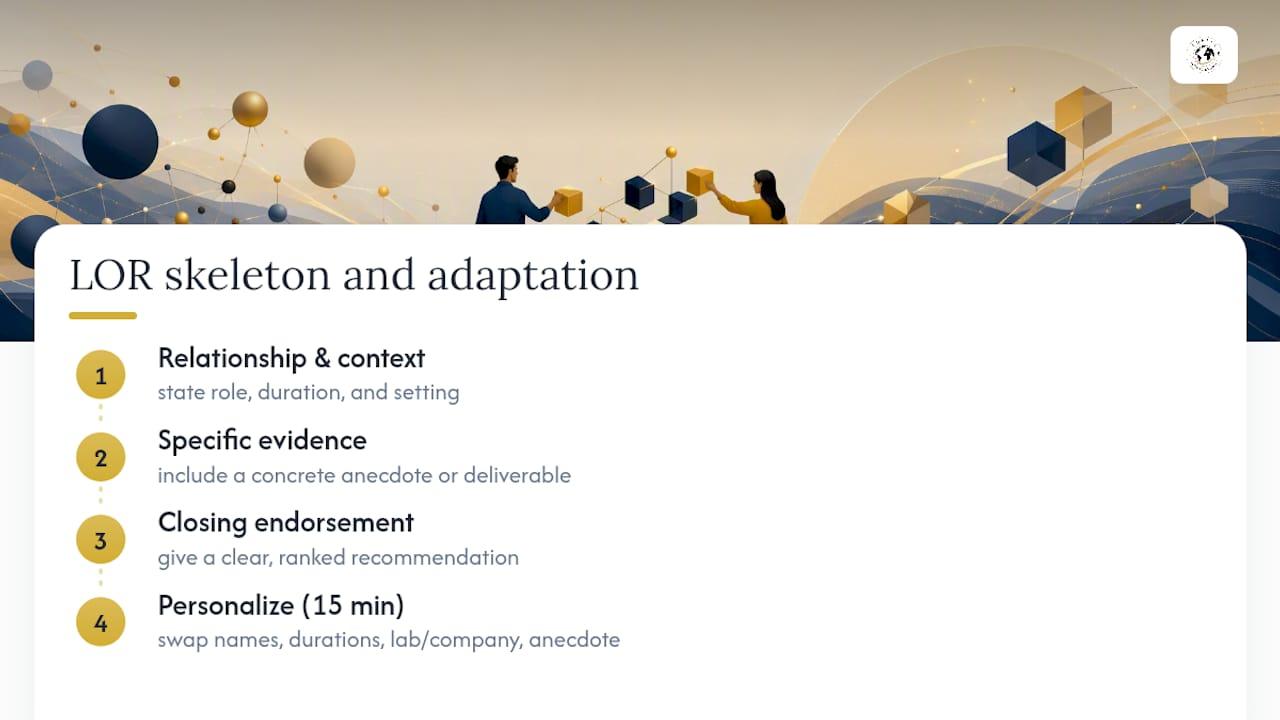
Each of these samples follows the same skeleton on purpose. Once you understand the structure, adapting a sample takes fifteen minutes, not an afternoon.
Letter of recommendation format: length, font and structure
A standard recommendation letter runs to one page, roughly 250 to 500 words, and that ceiling holds unless a programme explicitly asks for more. UChicago’s career advancement office confirms the same one-page norm across academic and professional contexts. Use a 12-point font, Times New Roman or Arial, nothing decorative.
Structure follows a predictable order that Excelsior OWL’s writing guidance lays out clearly:
- Salutation. “Dear Admissions Committee” or a named contact where possible.
- Introduction. Who the recommender is, and how long they have known the applicant.
- Body, 2 to 3 paragraphs. Each anchored in a specific project, incident, or achievement rather than a list of adjectives.
- Closing endorsement. A clear, unambiguous statement of support.
- Signature block. Name, title, institution or company, phone number, and email.
Letterhead matters more than people assume. A letter on official university or company letterhead, with a job title clearly stated, reads as more credible than the identical text on plain paper. Submit as a signed PDF unless the programme’s portal specifies another format, and always keep a copy for your own records.
Choosing recommenders and building a brag sheet
Seniority matters less than specificity. A junior manager who watched you solve a real problem writes a stronger letter than a department head who barely knows your name, because vague authority cannot substitute for a lived anecdote.
Most master’s programmes ask for two to three letters, with at least one expected from an academic source such as a professor or thesis advisor. Job applications typically need one or two, usually a direct supervisor.
- List 3 to 5 achievements with dates and measurable outcomes, not just job titles.
- Summarise key projects, including what you specifically contributed and what changed as a result.
- Attach your CV and highlight the two or three lines most relevant to this particular application.
- State your motivation for the programme or role in two or three sentences, so the recommender can echo your language.
- Suggest talking points, phrased as questions the recommender might answer rather than sentences to copy verbatim.
Pro Tip: Send your brag sheet at least three weeks before the deadline, and mention the exact submission method (an online portal link, an email address, a physical form) in the same message so your recommender never has to ask.
A prepared brag sheet is consistently cited as one of the simplest ways to improve how specific a letter turns out. Confirm the deadline, the confidentiality preference (waived or not), and set a polite calendar reminder to follow up a week before the letter is due.
Strong letters versus weak letters
A weak letter reads as generic praise with no anecdote to back it up. This is what admissions readers call the halo effect: an unrelentingly positive letter that never actually proves anything, because it never gets specific. Watch for these red flags in a draft:
- No contact details or institutional affiliation for the writer.
- A recommender who seems unfamiliar with the applicant’s actual work.
- Praise that contradicts other parts of the application, such as claiming leadership skills nowhere else evidenced.
Admissions committees consistently say they want a complete sketch of the applicant, the kind of behavioural detail that never shows up in transcripts or test scores. That is what a good anecdote supplies and a generic compliment cannot.
Turning a sample into a submission-ready letter
Getting from template to submitted PDF is faster than most people expect once the groundwork is done.
- Pick the closest sample from the ones above and replace every bracketed placeholder with a real name, date, and outcome.
- Attach your one-page brag sheet if you are the recommender receiving a request, or send one if you are the applicant.
- Offer to draft a starting point only if your recommender asks for one directly, then let them edit it into their own voice.
- Confirm the exact submission channel (portal upload, email attachment, physical mail) and request a signed PDF on letterhead.
- Send a short thank-you note once submitted, and keep a copy of both the letter and the submission confirmation for your records.
Edelia’s perspective: when a counsellor earns their fee
Most applicants can adapt a sample letter alone. Where it gets harder is juggling multiple international recommenders, conflicting deadlines, or competing offers that need comparing fast. Counsellors can step in, reviewing documents, coordinating recommenders, and keeping submission logistics on track so nothing slips through a portal deadline unnoticed.
— Edelia
Get hands-on help with your application documents
Sample letters get you most of the way there, but a full application involves far more moving parts: university shortlisting, SOP drafts, financial documentation, and visa paperwork that all need to land correctly and on time. Edelia’s counsellors review recommendation letters alongside the rest of your file, flag gaps before a university does, and coordinate timelines when you have recommenders spread across different time zones.
Edelia builds its advice around your actual academic profile and destination, not around which university pays the biggest referral fee. If you are applying to the United States and want a second pair of eyes on your documents before submission, book a free counselling session for your US applications and get a clear view of what your file still needs.
Sources
- Letters of recommendation | UChicago Division of the Social Sciences (application materials)
- How to write a letter of recommendation: Template & tips | Coursera
- Letters of recommendation | Excelsior OWL
- Parents and educators: How to write good letters of recommendation | MIT Admissions
FAQ
How do I actually write a letter of recommendation?
Open by stating your relationship and its duration, spend two to three paragraphs on specific anecdotes that demonstrate the person’s strengths, and close with a direct statement of support alongside your contact details.
What details must a recommendation letter include?
A complete letter needs the writer’s relationship to the applicant, its duration, two or three specific anecdotes, a comparison to peers where possible, a clear endorsement, and full signature and contact details.
How do I write a recommendation letter for a job application?
Focus on measurable results from the person’s actual work, describe one situation where they solved a real problem, and confirm you would hire or work with them again in your closing line.
How many recommendation letters do master’s programmes usually require?
Most master’s programmes ask for two to three letters, with at least one typically expected from an academic referee such as a professor or thesis supervisor.
Recommended
Created with BabyLoveGrowth to grow site authority
This article is produced by independent writers.
EDELIA is not responsible for the wrong use of information provided.